




※ GPS-HALP INTRODUCTION
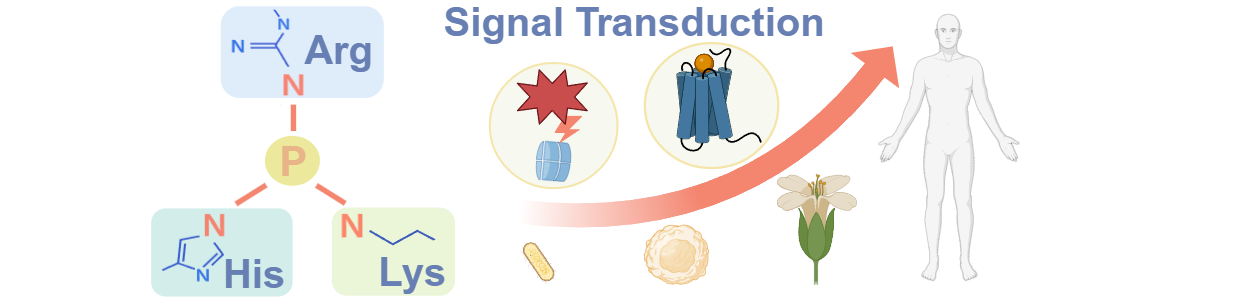
N-phosphorylation that forms high-energy phosphoramidate bond has attracted great attention for its conservation in both prokaryotes and eukaryotes, as well as its functional relevance in human diseases.
Here, we report a webserver, GPS-HALP, histidine, arginine and lysine phosphorylation, for prediction of H/R/K phosphorylation sites (p-sites), ranging from E. coli to H. sapiens. First, multiple deep learning frameworks were used to pre-train a general model of phosphorylation, using 1,624,460 O- and N- phosphorylation sites. Then, transfer learning was conducted to first fine-tune a N-phosphorylation model, using a benchmark data set of 7,655 N-phosphorylation sites, showing a >12 folds than other existing tools. Finally, histidine-, arginine- or lysine-specific predictors were further fine-tuned for 29 species. For comparison, we further collected an independent data not used in training, containing 480 known histidine N-phosphorylation sites. Compared to other existing tools, GPS-HALP exhibited a higher accuracy, and only GPS-HALP could predict N-phosphorylation in arginine and lysine residues. For users, one or multiple protein sequences or identifiers could be inputted, while the prediction results will be shown in a tabular list. Besides the basic statistics, we integrated the knowledge of 11 public resources to annotate N-phosphorylation sites, including but not limited to disorder propensities, 3D structures, tissue-specific expression, single-cell expression, and cancer mutation information.
For the help of GPS-HALP and the tutorial, please refer to the USER GUIDE page.
For the source code of GPS-HALP, please visit the GitHub page.
▼ Example
 STATISTICS